
How Do I Measure Weapons Detection? Understanding Alarm Rates
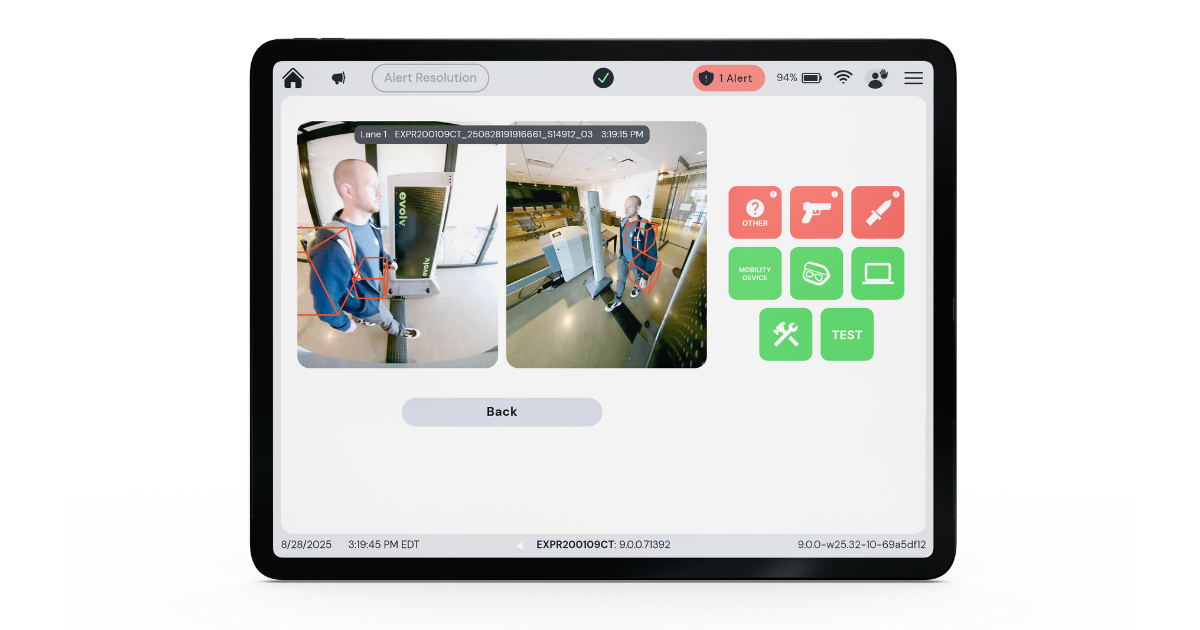
A weapons detection system could alert constantly and still miss the threat that matters. It could also alert less often and still have strong detection performance.
That is why alarm rate alone doesn’t tell you if screening is effective. Once you understand what is behind alerts, it gives a better idea of how a system is performing.
What Actually Defines Detection Performance?
At a high level, a good screening system should do two things well: detect weapons and confidently clear everyday items.
When we say “clear,” we mean the system can distinguish between a real threat and common personal belongings such as phones, keys, wallets, bags, and other everyday items without unnecessarily pulling visitors into additional screening. That distinction is what defines performance.
For years, the industry has relied on “alarm rate”, or how often a system alerts, as a key metric. In many cases, higher alerting has been accepted as the tradeoff for making sure nothing gets missed. This view is useful, but it’s also incomplete.
Not all alerts are equal. When everything is grouped into a single alarm rate, you lose visibility into how well the system is actually performing.
A high alarm rate can create:
- Long lines
- Constant interruptions
- Additional workload for staff
- Potentially an increase in guard fatigue leading to human error.
At the same time, missing a real threat isn’t acceptable. Performance has to be understood from both perspectives.
Instead of looking at alarm rate as a single number, it helps to break it apart. How many alerts are real findings (true positives)? How many alerts are caused by harmless items (false positives or nuisance alerts)? And perhaps most importantly, how often does the system miss something it should detect (false negatives)?
But measuring those metrics isn’t easy.
Why Measuring Performance Is Difficult
Unlike a testing lab, real-world screening involves an almost limitless combination of bags, personal belongings, and venue-specific conditions. And these factors can change daily. The items carried into a school, hospital, stadium, workplace, or entertainment venue vary significantly from one location to another. No testing program can account for every possible scenario.
Because of this, performance metrics should be viewed as benchmarks rather than guarantees. Vendors can provide test results and detection data, but no one can predict exactly what your alert rate or false alert rate will be in every environment.
Why Pilots Matter
That’s why evaluating a system in the context of your own environment is so important. A pilot can help you understand how often a system detects the items you care about, how it performs in the presence of everyday clutter, and how frequently it generates alerts that require additional screening. Most important, it allows you to evaluate performance based on your own environment rather than relying solely on vendor test results.
The goal is finding the right balance between detection performance and operational efficiency. In other words: maximize threat detection while minimizing unnecessary alerts. Work to keep people moving and keep weapons out.
Reducing nuisance alerts directly improves how a screening operation runs. Fewer unnecessary alerts mean fewer secondary checks, fewer disruptions at the entrance, less time spent investigating harmless items, and less chance for something to be accidentally overlooked due to fatigue or human error.
How Evolv Approaches Detection Performance
At Evolv, this is something we focus on deeply. Reducing nuisance alerts while maintaining strong detection performance is central to how we think about continuing to improve screening technology.
That’s also where solutions like Evolv Express® and Evolv eXpedite™ come into play.
One way to address unnecessary alerts is to separate what is being screened. When bags move through a dedicated bag screening process rather than being screened with people, security teams gain an additional layer of visibility while reducing the amount of bag-related clutter that must be interpreted during walkthrough screening.
The goal is an efficient screening operation: Staff spend less time resolving unnecessary alerts, visitors move through entrances smoothly, and security teams maintain visibility into potential threats.
What to Look for When Evaluating a System
When evaluating a weapons detection system, don’t focus on alarm rate alone. Look at the complete picture:
- How effectively the system detects threats
- How often it alerts on harmless items
- How well it supports the flow of people through your environment.
Remember, no system is perfect, but identifying the best possible balance of detection and throughput for your specific environment is critical in a positive security operation.

Evolv Express® Product Manager
Mateen Qureshi is the Product Manager for Evolv Express, where he drives product strategy and innovation. Prior to Evolv, he was a Product Manager in Cisco Meraki's IoT group and served as a Senior Consultant at Deloitte, where he helped public sector and healthcare clients launch new AI-driven digital products that improved outcomes for millions of citizens across the US. He holds a Bachelor of Science in Computer Engineering from Bucknell University and an MBA from Yale University.


