
How Security Leaders Plan Successful Screening Operations
Buying screening technology is not the finish line.
When security leaders evaluate physical security solutions, it is easy to treat hardware installation as the ultimate goal. But even the most advanced weapons detection system is only one component of a broader layered security plan. True security and operational success depend on how well that technology aligns with your site’s specific goals, traffic flows, physical environment, staffing model, and response protocols.
When security screening operations are designed without considering the human and spatial realities surrounding them, even capable technology can face friction: unpredictable lines, inconsistent alert handling, confused visitors, and fatigued security personnel.
Here is how security leaders build a comprehensive weapons detection operational plan that works in the real world.
1. Define the Security Objective Before the Lane Design
Before placing a single tower or configuring a system, leadership should establish clear operational parameters:
- Threat Profile & Access Rules: What specific items or threats are you screening for? What items are prohibited under organization policy?
- Scope of Screening: Who is being screened (students, staff, visitors, patients, ticket holders)? When does screening occur?
- Layered Integration: How does entry screening connect with access control, video security, emergency response, and overall layered security plan?
Defining these boundaries upfront can help ensure the system configuration supports your broader security strategy rather than operating in a silo.
2. Design Around Real Arrival Patterns
Specifications and throughput metrics demonstrate what a technology system can achieve under ideal conditions. However, real-world flow often depends entirely on local operating conditions.
This is where piloting under actual operational conditions can be valuable. A pilot period helps teams observe real arrival spikes, evaluate sensitivity settings against everyday carry items, and determine whether complementary bag screening workflows are needed to maintain steady progress.
Seven Questions to Answer Before Launch:
- What is our primary security objective?
Define specific target threats versus prohibited items to align system sensitivity with organizational policy and minimize unnecessary alarms. - Who will be screened, and during what hours?
Identify which groups (employees, visitors, students) require screening and during what timeframes to establish clear access boundaries. - What do our actual peak arrival patterns look like?
Map traffic surges during shift changes or event start times to determine the lane count and queue space needed to prevent bottlenecks. - Where will primary entry and secondary screening occur?
Designate walkthrough lane locations and a separate, adjacent secondary area so flagged individuals step aside without blocking main traffic. - What are the specific duties for each staff member on the lane?
Assign distinct, non-overlapping roles for flow control, alert resolution, and supervision to maintain order during high-volume periods. - How will entrants know what to expect before they arrive?
Use pre-arrival communications, online policy guides, and clear signage to set expectations and speed up physical throughput. - How and when will our leadership team review operational performance?
Establish regular post-launch reviews using throughput and alert data to continually refine staffing, schedules, and procedures.
3. Give Every Staff Member a Clear Role
Smoother screening benefits from defining distinct, non-overlapping responsibilities across the entry footprint:
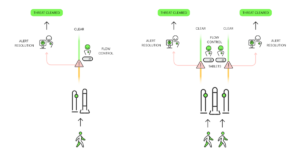
- Flow Control: Station staff to greet arriving individuals, encourage natural walking pace through the lane, and monitor system displays for potential alerts.
- Alert Resolution: Position security personnel beyond the primary screening point to conduct guided secondary checks when an alert occurs.
- Supervision: Designate individuals to monitor overall line dynamics, support accessibility needs, manage escalation, and provide real-time relief and direction.
Different facilities may require different staffing footprints. High-volume venues may deploy staff directly ahead of the primary lane to guide guest arrival, while corporate or healthcare settings may streamline roles based on facility constraints.
4. Build a Consistent Secondary Screening Process
What happens when a system alerts is just as critical as detecting the alert itself. When screening technology provides targeted visual guidance, such as highlighting where on the body or bag an alert occurred, staff can conduct a fast, focused, and standardized secondary screening process.
5. Treat Layout as Part of Performance
Physical space directly shapes human behavior and technical performance. Factors like lane placement, proximity to metal infrastructure or entry doors, queue formation area, lighting, weather protection, and line-of-sight for security staff can all dictate how well an entrance screening layout works.
6. Prepare the People Being Screened
Security screening should feel reassuring, clear, and efficient. Pre-arrival communication, clear perimeter signage, transparent bag policies, and well-trained, welcoming staff can remove guesswork for arriving guests and help ensure security measures feel like an organic extension of facility hospitality.
7. Train, Observe, and Continuously Improve
Effective operations prioritize continuous weapons detection training, reinforcing core skills and reviewing peak-period arrival flow, alert activity, staffing feedback, and visitor experience.
Utilizing operational data from tools like Evolv Insights® allows security leaders to refine Evolv Express® staffing ratios, adjust lane schedules, and address friction points based on clear, empirical evidence.
Building Your Operational Roadmap
The strongest screening program is never defined by technology alone. It is achieved when purpose-built technology, well-trained staff, thoughtful layout, and clear procedures work in total alignment. By taking a holistic approach to entry design, security leaders protect their facilities while maintaining an inviting, dignified experience for everyone who enters.

Senior Director of Technical Sales and Solutions
Conrad Laurion is Senior Director of Technical Sales and Solutions at Evolv Technology, where he leads technical sales and solutions engineering across North America. He joined Evolv in 2021 as a Solutions Engineer and moved up to Team Lead, then Director, and then into his current role. Over that time he has helped build the team that brings Evolv’s security screening technology to customers. Before Evolv, Conrad served nearly seven years as an officer in the United States Marine Corps. As Officer in Charge at the Mountain Warfare Training Center in Bridgeport, California, he oversaw the training of 5,000 Marines in the extreme winter and summer conditions of the Eastern Sierra Nevada. He ran three formal leadership schools and wrote the curriculum for three leadership courses. Earlier, as Deputy Officer in Charge with Marine Forces Central Command in Afghanistan, he was project manager for the Marine Corps’ first MQ-9 Reaper launch and recovery site. Working under hostile conditions, he coordinated General Atomics contractors, military units, and local suppliers to reach initial operational capability on the $40 million program ahead of the Afghan presidential elections. He began his career as a Platoon Commander with the 2d Light Armored Reconnaissance Battalion. There he led a 40-Marine detachment on an independent eight-month deployment across the Middle East and North Africa and kept more than $32.5 million in equipment above 90% readiness. Conrad brings a Marine officer’s discipline, calm under pressure, and focus on mission to building customer relationships and high-performing technical teams.


